WORK, LEISURE, and FAMILY:
- Work and occupational choice, career satisfaction
- Most people work for personal fulfillment, not just money
- Work is a source of identify and purpose: "I'm a carpenter / salesman / nurse / teacher"
- Career construction theory: People build their own careers:
1. Pursue what I'm good at 2. Pursue what I enjoy 3. Avoid what I dislike or can't do
- Bandura: Social-cognitive Career Choice: Career choices influenced by:
- 1. Self-efficacy (my belief in my abilities)
- 2. Outcome expectations (what I think will happen)
- 3. My interests
- 4. Goals (what I want to accomplish); includes occupational prestige
- 5. Environmental strengths and supports
- 6. Environmental barriers
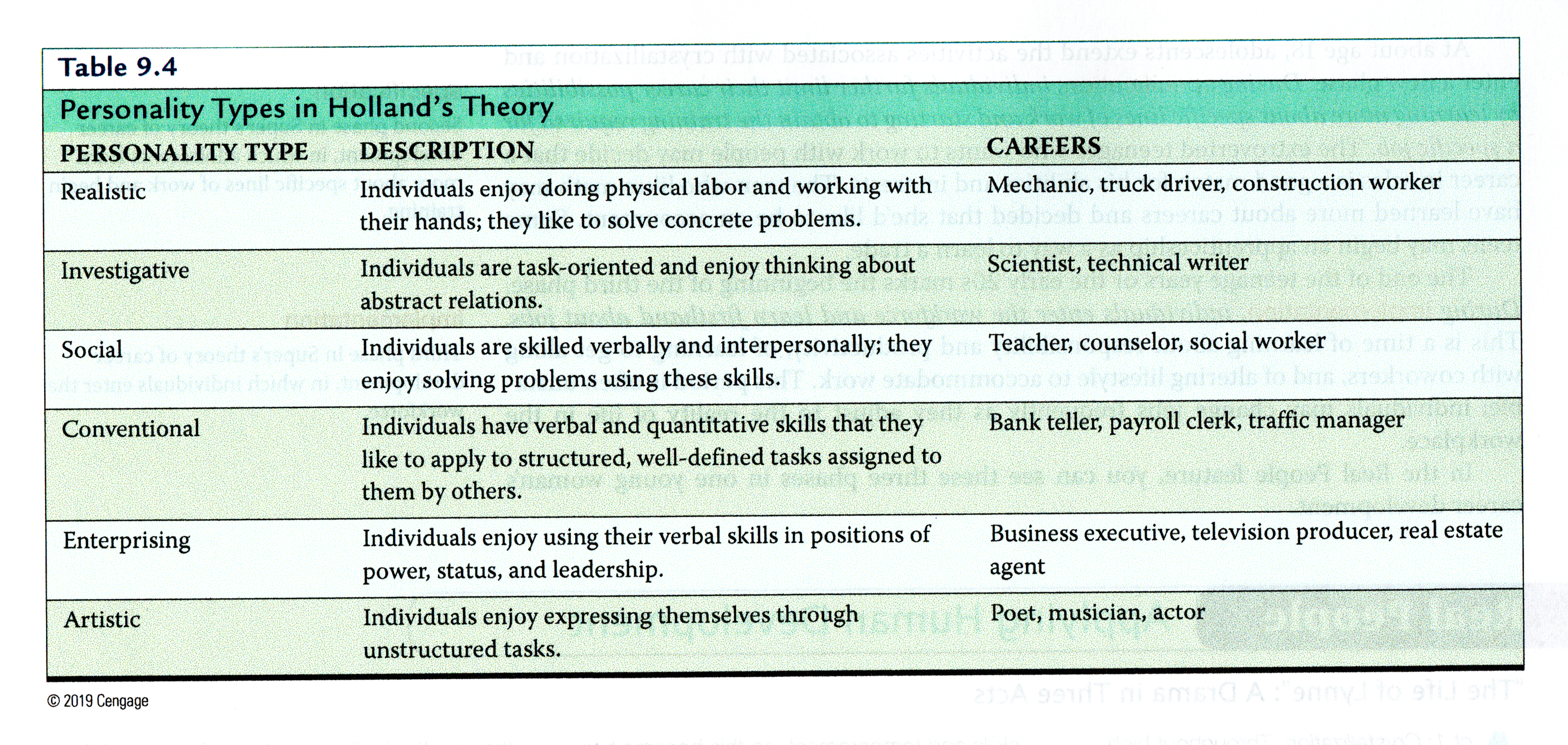
- Holland: based on personality types--
- Super: Five developmental tasks (first 2 in adolescence, others in adulthood):
- 1. Crystallization ("What am I good at?")
- 2. Specification and training
- 3. Implementation (Try it out via summer work, internships, shadowing)
- 4. Stabilization (Settling into a job with expectation of permanence; Establishment of career)
- 5. Consolidation and Maintenance of skills; Advancing up career ladder
- Afterwards: 6. Deceleration, then 7. Retirement
- (Numbers 3 through 7 are also called Stages of Adaptation)
- CHANGING CAREERS may require going back to an earlier step.
- Occupational expectations vs "Reality shock": Minimized by shadowing, internships, practicum.
Teaching and nursing professions do this a lot; also apprenticeships in construction trades, etc.
Mentoring and Developmental coaches can help, so can knowing someone in that career (having a model to follow).
Mentoring is especially helpful to women, minorities, poverty backgrounds, or those who don't know anyone in that career.
TEAMWORK always helps!
- Job satisfaction: "Psychological capital theory": Positive outlook improves process and outcomes
- Alienation: feeling that one's work is not appreciated; work makes no difference
- Burnout: depletion of one's energy, motivation, and idealism
- Passion for career may protect against burnout
- Vallerand-- types of passion:
- "Obsessive passion" (ignoring life outside of work)-- leads to conflict, then burnout
- "Harmonious passion" ("I choose to do this"; "I could always stop, but I like doing this"--
--leads to job satisfaction, less risk of burnout
--"work/life balance" is especially important for people with families.
- Gender, ethnicity, bias, discrimination:
- About 60% of U.S. adult women work. Studies of their children show that part-time work has benefits
for the children (compared to not working), but full-time work (especially in poor women) often interferes with parenting and has negative impacts.
- Increasingly, more women now work in "nontraditional" roles (formerly or still dominated by men); "skilled trades" (plumbers, electricians, carpenters, machinists) are still male-dominated.
- Men ofter prefer to date and marry women in traditional roles (nurses, teachers, social workers).
- Sexual harassment is a problem in many workplaces, esp. where women are nontraditional.
- If a company rewards individual accomplishment only (and self-sufficiency), women often leave or stay away.
- Women are more attracted to jobs that value teamwork, collaboration, interdependence.
- Companies can support women with daycare (nearby or on-site), flexible hours, and maternity leaves.
- On average, women earn about 80% as much as men doing similar work (but it varies, 70%-90% in different places and industries).
- Ethnic and racial minorities: Less research. One big barrier is unfamiliarity with (less exposure to) many occupational choices.
- Bias and discrimination-- illegal, but earnings still tend to be lower for minorities and women.
- Age discrimination occurs also. Often occurs as "boomerang employees" who are let go, then hired back later as Part Time with no benefits.
- Occupational adjustments and changes; job security and insecurity:
- Career plateauing-- lack of challenge (or employee doesn't wish advancement)
Solutions: employer retrains, or employee changes fields
- Occupational insecurity leads to stress.
- Coping with job loss and unemployment (more often for minorities; more often if less educated)
- Plan realistically; beware of "stopgap" (temporary) solutions persisting long-term.
- Job loss takes a toll on families, employee's mental health, etc.
- Work and Family obligations:
- Parents & other caregivers (incl. those caring for elderly dependents)-- often overworked; leads to stress.
- Family leaves (not just for maternity): taking time off when necessary (e.g., dependent is sick).
- Workers in these situations need family support, esp. from spouses.
- Employer responses to keep employees: Allowing time off; daycare (nearby or on-premises) or back-up care.
- Multiple roles for spouses; sharing household chores (but women still do the most).
- Work/family conflicts and juggling schedules is especially hard for dual-earner couples (esp. if children, too)
- Leisure activities-- choices usually established before adulthood:
- Arts, music, and other creative activities
- Sports (participant or spectator), including family outdoor activities like camping, hiking, fishing
- Travel
- Benefits: relieves stress; renews sense of purpose; often promotes family togetherness
MIDLIFE CHANGES: (Only occasionally a "crisis")
- Midlife physical changes incl. reproductive changes
- Loss of bone density (esp. in women after menopause)--
Selective Estrogen-Receptor Modulators (SERMs) often prescribed
- Loss of muscle strength
- Arthritis-- loss of cartilage and synovial fluid in joints
Osteoarthritis is most common; Rheumatoid arthritis has inflammation also
- Reproductive changes in women:
Climacteric (transition from reproductive to nonreproductive status);
includes menopause (cessation of menstruation) and large decline in estrogen levels.
Some women opt for Hormone replacement therapy (but it may increase some cancer risks)
- Reproductive changes in men:
Gradual decline in testosterone; May develop erectile dysfunction (esp. if hypertension also)
WARNING: Testosterone supplements or similar compounds often raise cancer risks!
- Stress:-- unhealthy if repeated or prolonged
NOTE: "stressor" is the external event or condition; "stress" is the body's response)
- Coping with stress: "Fight or flee" more common in men; women may instead "tend and befriend"
- Primary appraisal: Irrelevant or Benign ("eustress") vs Harmful ("distress")
- Secondary appraisal: "What can I do?" --successful coping
- Sometimes needs Reappraisal (new primary or secondary appraisal) from professional
- Effects of stress (esp. distress) may include: more LDL cholesterol, higher blood pressure (hypertension), cardiovascular disease, PTSD
- Coping can be problem-focused or emotion-focused
Reinhold Niebuhr's prayer: "May God grant me the serenity to accept the things I cannot change [emotion-focused],
the courage to change the things that I can [that's problem-focused], and the wisdom to know the difference."
Also, "You can't control external events, but you can often control how you react to them."
Emotion-focused responses may include religion, Yoga, "mindfulness", meditation, exercise
Many studies show that these methods all work and have many positive benefits.
- Mature intelligence and cognition; greater experience and wisdom; lifelong learning
Creativity (of artists, composers) peaks in 30s and 40s (ancient Greeks said age 40)
- Midlife personality traits-- Five dimensional factors:
- 1. Neuroticism (anxious, hostile, vulnerable)
- 2. Extraversion (boundless energy, vs quiet, passive)
- 3. Openness to experience
- 4. Agreeableness (willingness to work with others)
- 5. Conscientiousness (hard-working, ambitious, vs lazy)
- These traits tend to remain stable over time across adulthood
- Personality growth: personality adju stment is normal, usually gradual, often in response
to new experiences or new situations.
- "TESSERA" to account for personality change or stability:
Triggering situations, Expectancy States,
State Expressions, ReActions
- Changing priorities in midlife:
- Erikson- "Generativity" = helping others to achieve instead of achieving yourself
(Failure to do this is "stagnation")
- McAdams: Cultural demand and "need to be needed" leads to concern for next generation ("generativity"),
leading to commitment, then action.
- Transitions in family life-- changing family dynamics:
- "Kinkeeper": Someone (usually a woman) becomes organizer of keeping distant family members in contact, gathering them to plan celebrations, etc.
- "Sandwich generation": caring for children and also for aging parents
- "Empty nest"; "Letting go": setting up children in college or in adult roles
- Taking on new (or reclaiming old) hobbies and interests
- Care for elders: may be stressful, but also rewarding; greatly valued in many Asian cultures
- Grandparenthood: High value, satisfaction, meaningful in most cases;
Includes: Direct "extra" parenting and child care; also helping the parents in other chores
More important in many traditional cultures (Grandparents revered as sources of wisdom, keepers of traditions)
Grandparents may step in as substitute parents when needed, momentarily or short-term or long-term (but legal custody may be an issue if parent is unable to care for children)
|