Bates College

Broadly defined, I am interested in the synthesis of highly oxygenated naturally occurring compounds. Research in my group can be divided into two categories: carbohydrate chemistry and spiroketal containing natural products.
This project is funded in part by a Cotrell College Science Award.
2-Deoxyglycosides (2-deoxy refers to lack of oxygenation at C2 of the sugar,
and glycoside refers to the linkage between a carbohydrate and another molecule)
are commonly found in many antibiotics, and in many cases, contribute to
the biological activity of the antibiotic. Access to 2-deoxyglycosides has
become increasingly important with the development of new drugs, which rely
on a carbohydrate domain for their activity. 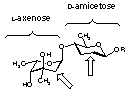 For example, the disaccharide shown here contains two 2-deoxyglycosides (the
C2 positions are indicated arrows), L-axenose and D-amicetose. Since 2-deoxysugars are not readily isolable
from nature, it is not only important that we be able to prepare them in
the laboratory, but the synthesis must be flexible to accommodate a large
range of functionalities. The very aspect that sets 2-deoxysugars apart
from fully oxygenated sugars (lack of functionality at C2) is also an impediment
to their synthesis. Traditional glycosylation of fully oxygenated sugars
often relies on the C2 functional group, both as a facilitator of glycosylation
(anchimeric assistance), and as a stereochemical guide for glycosylation.
With the C2 functionality missing, stereoselective glycosylation can be more
difficult. Numerous methods have been successfully employed for the synthesis
of 2-deoxyglycosides, but many of these methods are not universally applicable
to all 2-deoxyglycosides.
For example, the disaccharide shown here contains two 2-deoxyglycosides (the
C2 positions are indicated arrows), L-axenose and D-amicetose. Since 2-deoxysugars are not readily isolable
from nature, it is not only important that we be able to prepare them in
the laboratory, but the synthesis must be flexible to accommodate a large
range of functionalities. The very aspect that sets 2-deoxysugars apart
from fully oxygenated sugars (lack of functionality at C2) is also an impediment
to their synthesis. Traditional glycosylation of fully oxygenated sugars
often relies on the C2 functional group, both as a facilitator of glycosylation
(anchimeric assistance), and as a stereochemical guide for glycosylation.
With the C2 functionality missing, stereoselective glycosylation can be more
difficult. Numerous methods have been successfully employed for the synthesis
of 2-deoxyglycosides, but many of these methods are not universally applicable
to all 2-deoxyglycosides.
Our group is working to expand on a synthetic method originally developed
by Kessler, in which simple, primary oxygen and sulfur nucleophiles undergo
Michael-type addition to hex-1-en-3-ulose derivatives of glucose and galactose
to form oxygen and sulfur glycosides. By expanding the 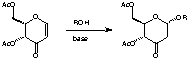 list of potential nucleophiles for this reaction, disaccharides and oligosaccharides
can be prepared. The C3 ketone present in the product will allow for additional
functionalization following glycosylation. For example, the ketone can undergo
stereoselective reduction, nucleophilic addition to give branching, reduction
and methylation, reductive amination, or introduction of a branched nitro
group. Thus, an in depth study to find optimal conditions for conjugate
addition of deactivated alcohols provides an opportunity for the synthesis
of a large variety of 2-deoxyglycosides, and would add to the general knowledge
of the chemistry of these systems. Ultimately, we will demonstrate the utility
of this reaction by synthesizing the disaccharide shown above.
list of potential nucleophiles for this reaction, disaccharides and oligosaccharides
can be prepared. The C3 ketone present in the product will allow for additional
functionalization following glycosylation. For example, the ketone can undergo
stereoselective reduction, nucleophilic addition to give branching, reduction
and methylation, reductive amination, or introduction of a branched nitro
group. Thus, an in depth study to find optimal conditions for conjugate
addition of deactivated alcohols provides an opportunity for the synthesis
of a large variety of 2-deoxyglycosides, and would add to the general knowledge
of the chemistry of these systems. Ultimately, we will demonstrate the utility
of this reaction by synthesizing the disaccharide shown above.
The spiroketal enol ethers found in Asteraceae (which includes the well
known chrysanthemums, some of which are shown on this page) contain 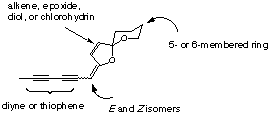 a wide variety of functionality. For example, the E and Z alkene isomers
are typically found in the same organism. [4.4] as well as [4.5]-type spiroketals
have been isolated. Oxygenation or unsaturation may occur on either ring,
but alkenes, diols, epoxides, and chlorohydrins are especially common at
C3,C4. The sidechain typically contains an ene-diyne, but thiophenes may
replace the diyne. There have only been two reports on the absolute configuration
of these compounds, but a wide variety of stereoisomers have been isolated.
There have been several reports on the synthesis of these compounds, and
a single report on an enantioselective total synthesis. Our plan for the
synthesis will start from D-ribose, and will allow
us to make a large number of analogs of these compounds enantioselectively.
a wide variety of functionality. For example, the E and Z alkene isomers
are typically found in the same organism. [4.4] as well as [4.5]-type spiroketals
have been isolated. Oxygenation or unsaturation may occur on either ring,
but alkenes, diols, epoxides, and chlorohydrins are especially common at
C3,C4. The sidechain typically contains an ene-diyne, but thiophenes may
replace the diyne. There have only been two reports on the absolute configuration
of these compounds, but a wide variety of stereoisomers have been isolated.
There have been several reports on the synthesis of these compounds, and
a single report on an enantioselective total synthesis. Our plan for the
synthesis will start from D-ribose, and will allow
us to make a large number of analogs of these compounds enantioselectively.
Dan Pitts Summer 2004,
Ind. Study fall 2004
Allison Wensley Senior Thesis: 2004/2005
Jess Perrie, '05 Summer 2004, Senior Thesis: 2004/2005
Andrew Hardy, '04 Ind. Study fall 2002, Senior Thesis: “Toward
a Flexible Synthesis of Polyacetylene Spiroketal Enol Ethers” 2003/2004
Brent Mann, '04 Summer 2002, 2003,
Ind. Study 2002/2003, Senior Thesis: “The Synthesis of 2-Deoxyglycosides
Through Conjugate Addition” 2003/2004
Kate Kolstad, '04 Senior Thesis: "“Effects
of Tetrandrine (TET), Isolated from the Chinese Herb, Stephania tetrandra,
on NMDA Receptors Expressed
in Xenopus laevis Oocytes.” 2003/2004
Hilary Domush, '03 Summer 2002; Senior
Thesis: "Synthesis of 2-Deoxyglycosides by Conjugate Addition" 2002/2003
Andrew Prigodich, '03 Senior Thesis: "Synthesis
of Pyran Rings via SN' Epoxide Ring Opening" 2002/2003